Wednesday, June 25, 2008

Real estate FDI inflow up nearly five-fold

- Chellamuthu Kuppusamy
Quite understandably there are reports on surging inflation, increasing interest rates and the potential impact on housing sector etc flowing across. This, along with FIIs pulling out from Indian equity market, is not surprising indeed. But here is an interesting piece of information that goes against this theory. FDI investment in real estate sector has increased nearly five-fold this year.

Courtesy: Hindu business line.


New Delhi, June 24"
The Indian real estate and housing space emerged as the darling of foreign investors in 2007-08, clinching FDI equity inflows of about Rs 8,749 crore, a near five-fold increase over FY07.
“The investors have seen that the real estate potential in India is huge. The returns are quite attractive. In fact, we see the trend picking up even further this year as the prices are getting more attractive for investors,” Mr Ramesh Sanka, Chief Financial Officer at DLF said.
Late last year, DLF Ltd had sold 49 per cent stake in eight residential project SPVs to private equity investors for a total consideration of Rs 1,675 crore.
A Merrill Lynch & Co entity had bought 49 per cent equity in seven residential projects in Chennai, Bangalore, Kochi and Indore for Rs 1,481 crore. The company — headed by Mr K.P. Singh — has also diluted 49 per cent stake, in another middle-income housing project in Panchkula, Haryana, to Brahma Investments for Rs 194 crore.
According to data released by the Government on Tuesday, the real estate sector, thrown open in 2004-05, saw the FDI picking up significantly between FY05 and FY08; it was Rs 171 crore in 2005-06 surging to Rs 2,121 crore in 2006-07.
“Over the last three years, there has been a build-up in investor interest. We saw the impact of that interest and euphoria for FY07 and FY08 as new townships and projects were announced. Depending on the asset class within real estate sector, the average rate of return stood at 25-35 per cent for India, against a global average of single digit return,” Mr Sanjay Verma, Executive Managing Director, South Asia, of Cushman & Wakefield said.
“However, at the beginning of the current year we have seen some asset bubble deflation. With prices moving southwards, choppiness in the stock markets, pressure on interest rates and global issues, while deals will still happen, pricing will be the question,” Mr Verma added.

Wednesday, July 11, 2007

Warren Buffett Biography in Tamil

- Chellamuthu Kuppusamy

My second book has been released in Tamil.


It was a great pleasure and opportunity to write the biography of Warren Buffett, one of my lifetime heroes, in Tamil. I don't want to waste more words here.

A detailed post about this book in available at this link

Warren Buffett - an Investograhy is my English biography on Warren Buffett

Thursday, May 10, 2007

My book on prudent stock investing!

- Chellamuthu Kuppusamy


My book on prudent stock investing with the title ‘izhakathe’ (இழக்காதே! - Meaning Don't loose) is released in tamil.

Efforts are on to bring this out in English as well.

Tuesday, May 08, 2007

Indian, Lanka, Sethu & Ram Bridge

- Chellamuthu Kuppusamy

Hot debates are floating around in the national capital New Delhi as well as in Chennai, and Colombo is keenly watching with plenty of curiosity. If you assume it is about LTTE and the eternal domestic conflict in that beautiful island, you are mistaken. What I am talking about is the Ram bridge issue.

Parts of India and Sri lanka were originally not part of Asian continent. Lemuria, as geologists call it, was a continent east of Africa or an extended part of that. It gradually moved and collided with Asian plate. The pressure created by that impact erupted the Himalayan mountains. Srilanka was part of the Indian subcontinent and over the years sea swallowed some of the low lying areas and thus separating Ceylon and India.

Even today that particular section of Bay of Bengal is not deep. (Great national poet Subramanya Bharathi sang, ‘lets us level sethu and build it to a street in order to reach Singala island’) It is very close to Rameshwaram and refugees often venture to swim across to reach rehabilitation camps, albeit being bad in condition, on our shores. This section of the see is known as palk straight, through which only boats can sail. Thinking of any ship is absolutely out of question.

Nagapatnam port, which is way in to the sea now, was focal point for sea trade of the powerful Cholas empire. After British established their presence in Madras (Chennai), it turned out to be their political and trade center of South India. Tuticorin is a harbor on eastern coast of south India and has been the port of Pandiya dynasties for centuries. Even now considerable direct trade takes place at Tuticorin port, which is a natural port unlike that of Chennai.

Well, how do all these matter to us, you might ask. If we look for three largest port in the word in terms of trade and activity, we find one of them in china. That is agreed as China is a massive country with huge population and plenty of international trade. However the surprise comes with the other two harbors.

One is Rotterdam in Netherlands, a country which flourished by trade even when the mighty British were conquering the entire world a couple of centuries ago. Holland is a tiny nation with around 15 million population. Their sea traffic is primarily dedicated to other European courtiers than Holland itself. Same can apply to the Amsterdam airport in that country, which is below see level.

Another port among the largest three is in Singapore, a city and a country, which raised itself among high per-capital income spot in the world. Much of its success came from its trade and service activities, as against any manufacturing and agricultural business. Their port creates lot of employment and plenty of income.

Singapore port is an important transit point. Most of the ships stopover for few hours and resume. Many Indian ships from/to the western coast are invariably among them. Ships operating between Europe and south east Asia are huge in number too.

Why do our ships halt at Singapore? Can’t we use one of the ports at our coat for this purpose? Yes, we can. Tuticorin is an obvious choice. But, if the ships stop over there, they have to go around Srilanka and then sail again. That makes it expensive and absurd. On the other hand, if pak straight is canalled deep enough to allow ships, life would be made simple.

It would potentially shift sizable port business from Singapore and Colombo to our shore. This has been the aspiration for nearly 135 years. Many attempts have been made in the past both in British India and Independent India to give a shape to this project. Due to various reasons, it was turned down or given up.

Sri Lankan government raised concerns and placed requests to New Delhi against the Sethu project for nearly more than 4 decades. You don’t need to be a rocket scientist to figure out the reason behind that. Surprisingly, India has assured at various occasions that this project, if (at all) gets implemented, will not affect Colombo’s economy. No one paid attention as to why we cared for other nation’s economy than our own.

This dream has (not fully yet) come true under the present Manmohan Singh government. More than Rs2,400 crores were allocated and reportedly the project is on progress. Ms.Jayalalitha opposed simply for the sake of opposing it. But, never mind. The show was on.

But, lately BJP, it’s parivars and some smalltime ludicrous personalities like Rama Gopalan have found Ramar Bridge, a bridge depicted in the Ramayana epic. They claim that Sethu project would destroy that bridge. They quote that Ramar bridge was built by orangutan army led by Hanuman to facilitate lord Ram reach the Lankan island to rescue his wife.

Ramar bridge was a natural formation as per geologists. Even assuming that there was a bridge, it should have been a stone bridge across the sea enabling trade and transport between India and the Lankan island mellenia, if not centuries, ago. Ove the years, it got sank into the sea. The very purpose of the bridge, even if it really had been there, has become obsolete many many years ago.

(Even going by the epic that it was made for Ram to confrot Ravana, what is the use of that now? Sita was already back and had agni bath to prove her purity. Now, Ram does not have to go back to Lanka again where he does not have any more wives captured. Even then the imaginary bridge is under the sea. How will he cross the sea?. He would better of taking a private jet)

All political parties aspire to gain control and be in power. But, taking religion and seting afire superstitious blief as a vehicle is certainly not the way. This becomes more severe when it turns against our economy and national prosperity.

In the late 1940’s there were three nations in south Asia freed from colonial clutches. These three nations, India, Pakistan and Ceylon (as Sri Lanka was called then) were led by three men educated in England namely, Nehru, Jinnah and Bandaranayahe.

But, unlike Nehru the other two gentlemen based their nationality and personal political success based on relegipous and lingual base. India remains the largest and greatest democracy in the world where democracy has been funny thing in Pakistan. Similarly, the island nation declared Buddism as the only allowable belief and Singala as the only language. It only aggravated and the state sponcered amry went on to demolish thousand of lives and tourched the greatest Jaffna library that served as the emblom of Tamil/Hindu tradition.

Fortunately, India was and still continues to be true a federal secular state, despite few horrible incidents forgotten along the sidelines of history. Thanks to our first prime minister Jawaharlal Nehru, multiple nationalities could coexist in this subcontinent under the same federal setup.

But, BJP and its allied forces are making an attempt to rewrite the history and present Savarkar in place of Mohandas Gandhi and Nehru. World histroy has seen nasty damages as religion was mixed into politics and administration. Some radical elements in few Islamic coutries seem to choose that path. BJP tries to match their act in every possible way. Any nation or tribe that wants to travel in the backward direction is destined to peril.

Congressmen may be corrupt and inefficient and that does not jusify making this subcontinent as a Hindu state. BJP arguably has more number of intellectual personalities compared with other political parties. But, mind if not directly properly would invite devil to dwell in there. Trust me, this view is not based on religious or political perspective, but on economical and rational.

These views are purely based on economical and rational viewpoint. No attempt is made to portay shipping minister T.R.Balu and his leader M.Karunanidhi, a shrewd politician as sacred cows. It will require a separate article to critize them.

If the sethu project is going to affect ecology, we need to investigate. But expert team has furnished feasibility report. Gladly we did not pay attention to Colombo’s outcry on ecological impact. If people argue that this project will affect fhishermen, that need to be carefully studied and find solutions. They may be real problems as well some politically motivated statement like that of Janalalitha.

But, if someone is trying to make politivcal milage out of relegious supersitions, we should go ahead, even if the bridge was constructed by Hanuman.

Some people augue that Sethu project would not really create any employment and improve the economy. Answer for that depends not only on the completion of the work, but also the port administration and easy to operate rules, just like Singapore. So, economic prosperity is not very sure without these additional changed. But, it is writing on the wall that it does not do any good to the economy by not going ahead with the project.

Sunday, April 29, 2007

A $ a day!

Courtesy : The economist

This month the World Bank announced that 986m people lived on the equivalent of less than one dollar a day in 2004—the first time it has counted fewer than 1 billion people in such a parlous state. The bank's definition of extreme poverty is stark, simple and even alliterative. In the latest issue of the Journal of Economic Perspectives, Abhijit Banerjee and Esther Duflo, of the Massachusetts Institute of Technology, describe it as a rhetorical masterstroke. But is it also entirely arbitrary? And how do the poor subsist on such a meagre amount?

When the bank decided to count the world's poor for its 1990 World Development Report, it did not take it upon itself to define them anew. Instead, a group of economists led by Martin Ravallion gathered together 33 national poverty lines that were already knocking about. India's line, for example, defined the poor as those who ate less than 2,250 calories a day. By its reckoning, this requirement would be met by the typical rural Indian spending 15 rupees a month at 1960-61 prices.

Mr Ravallion and his team converted rupees, pesos and rupiah into a common unit of purchasing power. Someone spending 15 rupees in rural India in 1960 had about the same command over goods and services as an American spending $23.14 a month in 1985. But India's benchmark was unusually abstemious. Half a dozen other poverty lines (for Indonesia, Bangladesh, Nepal, Kenya, Tanzania and Morocco) all fell within a few cents of a more generous allowance of $31 a month.

With that observation, the dollar-a-day concept was born, to appear in countless declarations, laments and pleas ever since. Halving the share of people who live on less than a dollar a day is, for example, the first of the Millennium Development Goals to which 189 countries subscribed in September 2000. (The concept's rhetorical appeal was diminished only a little when Mr Ravallion updated the threshold to $1.08 at 1993 prices, which is worth about $1.53 in today's money.)

Cigarettes and alcohol
But what does this line mean to the people who fall below it? Mr Banerjee and Ms Duflo describe the "economic lives" of the poor, drawing on 13 household surveys from Côte d'Ivoire to Mexico. The two surveys from India—undertaken in Udaipur's farms and Hyderabad's slums—they carried out themselves.

Vikram Seth, an economist before he was a poet, has described the "dreary pillage of privacy" these surveys entail. In 2001, for example, bank researchers in Timor-Leste diligently recorded whether a household bathed under a shower or in the river; used a flush toilet or a bucket; built their home from brick or rattan, and so forth. They also asked them to recall what they had eaten, drunk, chewed or smoked over the previous week: cassava or shrimp? Mung beans or papaya? Clove cigarettes or betel nuts? Beer or palm wine?

A dollar a day would seem to leave little room for choice or discretion. Hunger is surely the most binding of constraints. And yet these pillages of privacy show that the poor do make choices. They also suggest they are not always the best ones.

The poor do not complain much, the two authors note. (Only 9% of people in their Udaipur survey say their life makes them generally unhappy.) But they have a lot to complain about. Beset by hunger and illness, many are scrawny (65% of adult men in Udaipur are underweight), over half are anaemic, and about a seventh suffer from impaired eyesight. Many had to go without food on at least one day in the previous year.

And yet they do not eat as much as they could. According to Mr Banerjee and Ms Duflo, the typical poor household in Udaipur could spend up to 30% more on food than it does, if only it stopped devoting money to alcohol, tobacco and festivals. That last item, which includes weddings, funerals and religious events, typically accounts for about a tenth of the household's budget. This spending might be motivated by escapism—the poor have a lot to escape—or perhaps by social emulation. Even those in absolute poverty care about their relative standing.

The authors ponder not just how the poor spend their money but also how they make it. They describe the hard-pressed women of the Indian city of Guntur, who line the road each morning, mixing dosas over a kerosene stove for the price of a rupee. By 10 o'clock the women have turned their hands variously to making pickles, embroidering saris or collecting rubbish.
The poor, whether smallholders or petty entrepreneurs, lack scale and specialisation, Mr Banerjee and Ms Duflo point out. The farmers of Udaipur cultivate the land they own, no more, no less, but only a fifth rely on their plots as their chief source of income. In West Bengal, a poor household will typically have three breadwinners doing seven occupations between them.
It is almost an "item of faith" among development economists that the poor act rationally, however straitened their circumstances. If their undertakings are too small, or their efforts too thinly spread, to be efficient, it is not because they have miscalculated, but because the markets for land, credit or insurance have failed them. As one economist argued in 1993, "More than 40 years of research...should at last have laid to rest the thought that such folk may not know where their real interests lie."

But just such a thought is stirring again in the minds of Mr Banerjee and Ms Duflo. Why, for example, do more Ghanaian farmers not cultivate pineapples, which would fetch returns of 250-300% by some estimates? Why do so few farmers in western Kenya dress their fields with fertiliser, even after the benefits have been demonstrated to them?

"One senses a reluctance of poor people to commit themselves psychologically to a project of making more money," the authors write. When you live on a dollar a day it may be painful to confront your circumstances too squarely, or even to aspire to better things. The "great redeeming feature of poverty," George Orwell wrote after his excursions in the social gutters of Paris and London, is "the fact that it annihilates the future".

Friday, April 20, 2007

Strong rupee

- Chellamuthu Kuppusamy

There was a remark made in the previous post on Chidamaram's book.//Why is the government increasing the interest rate to curb liquidity and at the same time inject money by heavily buying dollar to maintain exchange rate? Are the FM and RBI of the view that Indian economy is not resilient enough to absorb strong rupee? //

This statement has beome obsolete within days. Rupee has peaked to its 9 year high. It is alledged that RBI has pulled back from obsorbing excess dollat floating in the market. Government has apparently decide to keep aside economy aside & cool down inflation. Well..how does exchange rate find its relation to inflation?

We have seen multiple interest rate hikes in the recent past to curb liquidity & thus arresting inflation. A good move indeed. But, there is other side effects too. Due to relatively attrative interest rates, foreign money - read dollar - flows towards India. This raises the demand for rupee and brings down the demand for dollar making exchange rate climbe (say from 44 to 42). RBI normally buys such incoming dollar and makes an attempt to maintain greenback demand constant, meaning weaker rupee. Having a stroung rupee is not good for our exports and eonomy as a whole. That is precisely the comment made in the book review.

When RBI buys dollar and injects more rupee into the system, it adds to liquidity and subsequently giving raise to inflation. The oroginal goal is defeated? May be, true. It is duty of the government to maintain moderate inflation as well as exchange rate. But, managing ecconomy is not that simple. They always try to strike a balance.

Having said that, RBI not going ahead in its normal act of sucking dollar is not a surprise. State elections in the north is onsidered to be a reason. One cant help thining that inflation is more of a politivcal factor than eonomic one at this junccture. Otherwise there is no need to let rupee gain strength. I dont have any reason to believe that FM and RBI are confident that Indian economy is resilient enough to absorb strong rupee?

Wednesday, April 11, 2007

A view from outside - P.Chidambaram

- Chellamuthu Kuppusamy

I am writing this from the city of Columbus in central Ohio, the United States. A coworker of mine shares an attention-grabbing information. It is about Indian finance minister P.Chidambaram.

He could not recollect exactly. It might be 2002 or 03. Mr.Chidambaram was out of power, even out of congress party. He was invited to a function in Columbus, organized by an Indian community. Political personalities attending such gatherings, while out of office, is not uncommon. But what is fascinating about this Harvard educated lawyer cum economist is his simplicity.

Former finance minister (at that time) flew all the way from India in economy class. Three and a half hours drive from Detroit was adequate for his commute to Columbus. He had not demanded another domestic flight, even after long journey in the sky. Story did not end there. He stayed with an NRI at his residence & surprisingly did not insist for hotel accommodation.

After the talk in the meeting, folks had offered him to take around the city. He refused and held that he had to write for Indian Express. Indeed, he went ahead and penned down thousand plus word column, despite getting intermittent calls from international bodies like world bank etc. That shows the level of discipline this market savvy politician is made up with. He wrote a column every week in Indian Express between August 2002 and March 2004, except two weeks.

All those articles are collected and tied to be named as ‘A view from outside’, a 372 page book, not to mention being priced at Rs.500. I am making a simple attempt to gaze through that work via a common man’s eyes.


He starts his first article on a positive note. “India is often described as a poor country. I disagree. It is a country where a large proportion of its people is poor.” He talks high that India can grow much much faster than rest of the world. But, growth is a function of investment. He augurs the need to eradicate all stumble blocks hindering productive investment. More emphasis can be seen towards public spending on infrastructure. We join our current FM in pressing the need to accelerate public investment and removing roadblocks for private investment.

At many instances he proves to be a smart politician, principally when it comes to criticizing then ruling BJP and it’s Hindutva policies.

Many of Chidambaram’s remarks on BJP’s term at the center applies now as well. Finance minister might like to forget these statements. He terms Vajpayee
“He presides over the most fractious coalition government ever to rule India. Not a day passes without one party or the other vehemently criticizing the government”

Should we forget the current government at the center flexing itself for every peril from left allies and regional powers like DMK? If one has mind that can be mould just by reading some articulate writing, it would be easy to get a feeling that it was only BJP that had differences in the government. Differences and compromises are not the rule of the game and accepted norm in a coalition government. Even current DMK government in Tamil Nadu faces unprecedented (is there a better word) pressure from its allies, including Chidambaram’s party itself for the first time.

One should have no doubts on his vision and economic acumen. Growth of nation and the living standard of her citizen is characterized by the per-capita consumption. BJP’s inability to push hard power sector reforms, initiate & even achieve preset targets in power generation capacity addition is indicated at various instances. We ought agree with FM on this matter. We are pretty pleased with government’s ambitious target of electrifying every home by 2012, which is no longer a paper target.

He touches upon agriculture, albeit them being short. Even he acknowledges.
“there were only three pieces on agriculture, but I was able to identify the real issues plaguing that sector: low investment, inadequate credit and poor farm-gate prices. These problems persist, but a beginning has been made to correct the situation.”

Book advocates for simple and transparent rules to be incorporated into our administrative system. Author even makes an attempt to touch the roots of corruption in our system and reasons why it stays undiminished. License raj obligated business leaders to be nice with ruler to receive favor, which is percolates down the pyramid to every taluk office and office boy, not to talk of clerks and officers.

Chidambaram also questions ourselves on the important issue of Kashmir. Our governments, for Chidambaram it is more of BJP than congress, have been very comfortable to point fingers towards Pakistan for every unrest in India. It is no different from Bush's 'war against terror' and Sadam Hussain being found guilty for every crisis US faces.

Our failure to embrace Kashmir and its people into national mainstream is cited. Dissident Panjabi’s are now in every walk of life. We have accommodated them on the national dais. Even DMK wanted separate nation and gave up that idea. It is a classical example on how a state (and political dynasties) can prosper through participation and involvement. India’s failure to handhold north eastern states is a symbol of disgrace.

‘A view from outside’ is predominantly economic outlook of this free market preacher. He has quoted lot numbers through the length and breadth of this work. I shall get into those details. Chidambaram’s advocate brain makes sure that he puts forward his views, criticism and comments with relevant statistics. That is some effort for a politician in Indian. No wonder why prime minister Dr.Manmohan Singh praises his finance minister and asks opposition to use their otherwise gratis time effectively.

He goes on talking on many issues ranging from child labor, honesty in politics, low tax – high compliance, fiscal deficit, usage of forex reserves, women empowerment, WTO, Kaveri water problem, tourism industry, budgets, disinvestment, FDI, tourism industry, LTTE and the list goes on. He proves with no doubt that he was Rajiv Gandhi’s pet. Rajiv had a dream and wanted to change the lives of millions. Agreed! But, Chidambaram’s efforts on Bofors are very explicit. Even he proclaims to have taken Vajpayee, a wordsmith himself, by surprise with his statement on this historic arms deal racket.

It is my honest belief that this articulate politician with his ‘scholar’ hat has done a fantastic work using his free time. I would say, “Its a must read”, if you don’t ask back, “Are his criticism hold good for his current governance & government?”

I want to add another question too. Why is the government increasing the interest rate to curb liquidity and at the same time inject money by heavily buying dollar to maintain exchange rate? Are the FM and RBI of the view that Indian economy is not resilient enough to absorb strong rupee?

Sunday, February 11, 2007

Mr.Honda - 30 yrs ago

A Talented Hawk Should Show Its Talons 1977

A book titled “Hoist Our Sails to take Advantage of Our Strengths,” published in June 1977:

Mr. Honda’s book, “Hoist Our Sails to take Advantage of Our Strengths,” published in 1977, is a new edition of the book of the same name published in 1967. This is an essay in which Mr. Honda insisted talented people should bring out their abilities to the fullest extent. Beginning this year, participation in TT racing resumed.

There are many different types of people. There are people who were born with outstanding talents and abilities. There are people who acquired talents through education or their own efforts. In contrast, there are people who do not have such gifts or talents, but who try to look as if they do. It takes a lot of effort and special skills to accurately evaluate and distinguish these different types of people from a large number of people. However, in Japan, there is an old saying that “a talented hawk hides its talons.”

This was an appeal to the public in the era when the cultural level of people was extremely low, so modesty was made to be a virtue. The trouble is that this thought is still highly regarded and emphasized. In other words, people who have excellent abilities are cautioned not to demonstrate such abilities, and those who don’t demonstrate true abilities are highly regarded. I am having a difficult time understanding why this old saying has been conveyed as if it is convincing. If the person rarely demonstrates the abilities, we don’t even know if the person actually has them. A person should be highly regarded only when his/her abilities are demonstrated and results are delivered. A person should not be highly regarded while he/she is still hiding the talons.

Moreover, holding back on your true ability does not work in this era of speed when things are constantly advancing. Precious abilities will be a useless possession. I am thinking this old saying should be deported from Japan. Instead, I want to insist on “talented hawks do not hide their talons.” In other words, we need to express ourselves saying, “This is how I think.” I want you to express yourself proudly – whether you are a hawk or a dove. I think there are kites or crows in addition to hawks and doves, and there is nothing wrong being a kite or a crow.

In this way, you can do a respectable job and feel your contribution to society only when you can completely understand and express your own individual qualities. Moreover, this strong confidence in your work will lead to your pride.

As long as we live, we will always be beset with various desires. We want to have money and pride. We want love. And we want to be healthy. In that sense, pursuing profit does not satisfy us completely. I am enjoying my life because I have a job that I am proud of. Thieves or swindlers obviously cannot be proud of their job, and thus have no fun.

Everybody is not a hawk. Kites and crows can also do some good depending on how they work. But that is possible only when we declare ourselves kites or crows. As long as we declare who we are, people should let us work in the way we can use our capabilities to the maximum.

In this world, there is nothing completely useless. Even rocks on the riverside become useful as concrete when they are mixed with cement. However, a diamond could be treated as a piece of glass or a rock on the riverside if it follows the concept of “a talented hawk hides its talons” or “silence is golden,” and does not assert itself. Such a non-assertive diamond will end up being buried in concrete. That is asking a little too much if you want to receive a good evaluation while remaining silent.

In other words, it is a virtue in the present day to clearly express one’s opinions and to efficiently provide data which effectively makes one’s value understood.

What will happen if young people keep silent? You must know the answers based on what I have been saying so far. In the area of politics, for instance, if people keep silent and display no reactions, we will not be able to tell if it is good or bad. The same holds for a company. Good company management is possible only by listening to the opinions of employees. A talented hawk not hiding its talons has a major positive impact in all senses.

Thursday, February 01, 2007

Tata steel & Corus - Are we cheering??

- Kuppusamy Chellamuthu

Three exciting things involving India and England have occurred recently. Shilpa Shetty winning big brother show in UK amidst racist comment by fellow contestant is certainly interesting. British telecom major Vodafone fishing for Indian cellular operator Hutch is seen as the recognition of India growth story by advanced countries. (NYSE taking a stake in largest Indian stock exchange NSE can be viewed under the same lines). While these two events are certainly noteworthy, what is fascinating is Tata steel's acquisition of British steel maker Corus.

This is the largest takeover by an Indian firm overseas for an all cash deal of $12.1 billion (Rs 53,361 crore). Tata's had to offer 608 pence per share. This is 5 pence more than rival bidder CSN, a steel company from another growing nation Brazil.

While the entire India Inc is celebrating this news, we don't have any disregard towards this brave attempt. Neither can we ignore it as an irrational exuberance, though signs of that are exhibited.

"Today marks the end of the journey that started quite some days ago. An Indian company is making the bid for a European steel company much larger than itself — it is something which has never happened," Mr Ratan Tata, Chairman of Tata Steel, said.

Tata steel – Corus combine would be the fifth largest steel producer in the world. 19 million ton capacity is added to the kitty.


A company is taking over another bigger than itself. One can't forget IT bubble towards the end of last century and the first few months of this century when unknown IT companies swallowed firm larger in size to bulge the balance sheet & book value. Sure, it is not fair to compare the Tata's with any of those 'get rich quick' dot.com companies. However, there is an apprehension that Tata is biting more than what it can chew.

Tata steel being one of the cheapest steel producer in the world, deserves due admiration. This acquisition would help it spread wings globally, Europe in particular. Finance minister P.Chidambaram has assured that the central government would facilitate this deal go through smoothly. Any flexing of rules from SEBI or RBI should not be a big problem. But, the main question remains the price.

While one compares Tata's initial offer of 475 pence a share with the final deal of 608 pence, there lies little difficulty in determining it to be a high priced shopping. Hindu business line reports, "The 608 pence offer is at a premium of about 68.7 per cent over the average closing mid-market price of 360.5 pence of Corus on the LSE for the 12 months ended October 4, 2006."

But, Tata steel's MD Muthuraman justifies the price. "At 608 pence a share, the enterprise value of Corus works out to $710 per tonne. Today, to set up a greenfield capacity, going downstream as much as Corus has in terms of tin plate capacity, galvanising capacity and construction solutions anywhere in the world, would cost somewhere between $1200 and $1300 per tonne"

But, overvalue or undervalue varies based on the yardstick we use. The final deal for Corus at an enterprise value of over $13 billion works out to multiple of approximately 7 times EBITDA (earnings before interest, tax, depreciation and amortisation) for the year ended December 31, 2005 and 9 times for the 12 months to September 30, 2006. This is much higher than 5.5-6 times paid by Mittal for Arcelor.

On an EV/tonne basis also, the deal works out to $710 per tonne, higher than the Arcelor Mittal deal, though in line with some of the standalone deals in this space.

Alright. How does the stock market see this transaction? Tata steel share price took a beating by 10%. Nothing more to add. Highly leveraged purchase would burn a big hole in the bottom line and net profit margin. A mammoth task is ahead of Tata's to unite both the entities both in terms of operation and culture.

How can one summarize this? Corus shareholders can start running towards their bank with all smile and 608 pence money. I am concerned with lot of caution as a Tata steel shareholder and feel proud as an Indian. This mega purchase is going to be funded by 53:47 debt-equity mode and has happened on the day when RBI hiked repo-rate by 25 basis points. At the end of the day 'it is a matter of pride'? Neeeeyyy.

Note : Facts, figures and news quoted from Business Line.

Saturday, January 13, 2007

Market panic - Business line letter

http://www.thehindubusinessline.com/2006/06/16/stories/2006061600511000.htm

My letter to the Hindu Business Line

Market panic

This refers to "Stock market panics when politics dominates economics," Business Line, June 15):

Structural inefficiencies, apparent reversal of pro-business policies by the Centre, spiralling oil prices, global tightening of liquidity and scarcity of easy money are some of the factors that the recent crash can be attributed to.

What was informative in the article was that most of the transactions occurring in the major two exchanges are speculative/intra-day/derivative trades.

Short-term investors, as they call themselves, are in fact traders or speculators. This recent correction might act as an antidote to the day-trading epidemic.
Kuppusamy Chellamuthu
e-mail

Tuesday, December 26, 2006

Rakesh Jhunjhunwala Speaks

From Hindubusiness line 26-Dec-2006.

`2007 will be year of consolidation and rise for the Indian markets'

Bangalore , Dec. 25

"Market is always right. Markets cannot be taught, they have to be learnt.

"We must have an attitude where we must balance fear and greed," was the hot tip by Mr Rakesh Jhunjhunwala, India's high-profile investor and President of Rare Enterprises, when he spoke at a seminar on `Wealth creation through equity investments' organised by Welingkar Institute of Management here on Friday.

Mr Jhunjhunwala spoke about his convictions that made a case for sustaining the India growth story.

Equities, because of their efficiency in allocating capital and ability to leverage, generated superior returns when compared to other assets over the long term, he said.
Since 1979, the Sensex has delivered 21 per cent returns compounded annual growth rate, which compares well with returns on funds managed by the legendary global investor Warren Buffet, he added.

Opportunities
Mr Jhunjhunwala said that enormous wealth was created over the last five years because opportunities in India have been manifold.

There is a strong case for investing in equities considering its under-penetration today.
He predicts the proportion of household savings to equity to rise to 15 per cent in 2011 from 4.5 per cent now as a result of which about $45 billion would flow into equity markets as against $6 billion now.

He expects 2007 to be a year of consolidation and rise for the Indian markets. According to him, the Sensex may have a floor at 12,500 and a peak at 16,500 in 2007.
Admitting that gains were going to be moderate in future unlike the manifold rise over the last few years, he advised investors to be realistic in their expectations.

He said that markets were unlikely to peak unless they were trading at a multiple of 25-30 times forward earnings. They are currently trading at about 16 times their earnings for financial year 2008.

Growth momentum
Speaking on the strength in India's fundamentals, he elaborated on forces that would sustain the growth momentum.

According to him, growth enablers (such as favourable demographics, higher base of skilled people and education base), liberalisation catalysts (such as competition), fall in interest rates, multiplier effect (on account of reforms), structural changes in quality of corporate earnings and micro trends (such as change in mindset of companies who are aspiring to become global) are likely to drive India's growth story to a higher level.

He, however, cautioned that investors should not forget the four-letter word `Risk' while making investment decisions.

"Patience may be tested, but conviction will be rewarded," he said. Mr K. Rajagopal, CIO, Reliance Capital Asset Management, and Mr Joseph Massey, Deputy Managing Director, MCX, were among other speakers on the occasion.

Tuesday, December 19, 2006

Best stock market analyst

- Kuppusamy Chellamuthu

Posting some of the mail discussions from 'india_next' yahoo group.

First:
I have been trading in stocks for the last three years and losing money (yearly 2.5 lakhs on an average). I have tried everything from trading on my own intuition to getting tips from experts. There havent been a single three months streak where I have made money. Now what should I do? Do somebody have any idea who is the best analyst in India so that using his tips we can also make money? I dont care if he is a technical analyst or a fundamental analyst. I am ready to daytrade, invest or scalp. Who is the best out there? Please send me a mail if somebody has an opinion. Please do not mix business with this and do not send business advertisements.

Second:
I have a seasoned investor friend who often says, "Trading is one of the most sophisticated suicidal methods".

When you do day-trading your odds of gaining and losing are evenly poised, leaving apart the money you have to make up for brokerage and taxes. When a person comes with an intention of trading, his chance of winning is 0.50 (50%). He can either go broke or get the money enabling him to go ahead to the next day. His chance of gaining on the end of second day is 0.50 (for the previous day) X 0.50 (for second day) = 0.25. His chance of winning is reduced to 25% and to 12.5% on the third day. This has been proven by history. People who go great money in stocks were not addicted traders.

You did not need to beat the index by a substantial margin. But, had you stayed invested in sensex companies, your money would have grown decently during the past 3 years, which has been the best time for Indian stock market. Unless you are a broker, you don't need to advocate trading.

And...As our motive in operating stock market is to make money, seeking day-trading tips is nothing but a quick solution to the question 'how to make money in a day?' I am completely convinced that any person who has an answer for this question won't need to make money by selling his 'tips'.

Aa such, I don't detest trading. But, want to be sure on what I am trading. Otherwise better prefer flying to Los Vegas to try my luck.

Regret if your question did not get answer. I also believe that no other member of this group am not knows any such 'tipsters' who can facilitate us make money.

And finally, you are lucky enough to learn things at the expense of three years and 2.5 lakhs. There are people who paid much more for some trivial lessons.

Friday, August 11, 2006

Interview of a Sri Lankan industrialist

This is an interview of a businessman in Sri Lanka that featured in today’s (11-Aug-06) Business Line daily.

It is interesting to see how this businessmen of this island nation look at India how our outsourcing sector looks at United States. Even among conflicts they are growing at a healthy rate. One should not be surprised to if service sector job slowly move from India to low cost countries like Sri Lanka. May be we should also encourage building up huge tourism industry.

Leaving other matters in the discussion apart, I always wonder why both politicians and businessmen of this island tried to constantly persuade Indian government not to go ahead with Sedhu project.

Thursday, July 27, 2006

GMR IPO..

- by Kuppusamy Chellamuthu

No activity off late in this as it was in the market for retail investors.
Drying volumes, beaten down prices, no cash to buy… none of them was surprise & new. Most hit was the primary market where quite a few companies pulled back their IPO plans and rest that dared got poor response.

Past few days sentiments apparently getting back. However every adverse reason that prevailed a month back still remains intact despite the fact that some of quality stock s available at comfortable valuation. I would love to see the market at the same levels or even further slide. That would give me a long stretch of consolidation period with few more paydays ahead. If buying stock at cheap valuation is the motto of investing, we have every reason to rejoice bear domination. But a bear can last anywhere between a minute to couple of centuries. DJIA was at the same levels in 1964 & 1981, 17 long years. Japanese index fell all the way from 30 thousands points to 4 digits.

You rarely know whether your date is expensive or not. A fancy girl can make a fatty credit-card bill for you to pay for months. As a matter of fact, it is rarer to predict the markets than a fancy girl.

Infrastructure major GMR ventures to tap the primary market, though with a reduced price band. It is learnt that George Soros' Quantum fund and ICICI ventures have taken sizable stake at the price higher than the propose price band. That does not assure anything at the outset for an investor. If this issue gets good response especially from retail segment, it might probably revive primary market sentiment. That should be a good news because that is the only money injected into companies' balance sheet and projects, indirectly fuelling economy. Secondary Markey irrespective of its rise & fall does not have direct influence on economy, except causing fluctuating income for brokers and traders.

GMR is the major stake holder in Hyderabad international airport and modernizing Delhi airport. Interestingly it own hundreds of acres of land around these 2 airports. Company is also into other infrastructure and power generation activities. That makes one interesting. However looking at Fy-2006 earnings its IPO price is at mammoth valuation of around 90 times. Leave the bal to the keeper & wait???

Thursday, July 06, 2006

Tata steel questions

People might have heard of events happening around Tata steel camp.

Promoter’s holding company Tata sons has decided to increase its stake in Tata steel through preferential allotment and warrants route. Though we understand it is intended to shun any potential hostile bid by steel baron Mittal, what I fail to understand are……

1. If injecting further money into the business was the motive, why can’t they go with all out preferential issue rather than some amount of warrants?
2. I hope warrants are another form of options (like ESOP for executives) where in promoter does not need to shell out money immediately, but with a premium (like a call or put option) at the time of Warrant issue. Given these assumptions being true, what would probably be the exercise price as pronounced by ‘SEBI prescribed price formula’?
3. This question is not directly related to Tata steel, but with games played around convertible warrants. Does any one have a clue on what the price determination formula that SEBI prescribes for an unlisted company is? Has anyone closely followed DLF case where minority shareholder was apparently betrayed by the greedy promoter? Are there any similarities between DLF and Tata steel warrants? If the real motive is to raise money, why can’t Mr.Ratan Tata provide warrants for every Tata steel shareholder instead of Tata sons?

The news item (from Hindu business line) is below for reference.
----------------------------------------
Separately, Tata Steel informed the BSE that it would issue on preferential basis 2.70 crore ordinary shares of Rs 10 each at a price of Rs 516 per share for Rs 1,393.2 crore to Tata Sons.
Also proposed were 2.85 crore warrants, each entitling Tata Sons to subscribe to one ordinary share of Tata Steel against cash payment. The promoter company would pay Rs 51.60 per warrant on allotment; Tata Sons can exercise its option after April 1, 2007but not later than 18 months from the date of issue, in accordance with SEBI prescribed pricing formula.
"You may ask why this injection of funds (Rs 6,500 crore ) is not being made as a rights issue to shareholders. The main reason for that is - through an overseas issue we can perhaps obtain prices that are close to market prices today, which, we would not be able to do in the case of shareholders who would justifiably want a discount, and a substantial discount from market value. This we will consider in time as we always have. But if we want to hold dilution to a minimum and protect existing shareholders, we expect to raise these funds in a manner that it will not exceed 15 per cent of the prevailing paid-up capital of the company.

Wednesday, June 21, 2006

Two IPOs withdrawn..

Two companies Bluplast Industries and Vigneshwara Exports have decided to withdraw their IPO due to poor response. This was done as a result of mere 89% subscription even after price band was brought down to Rs 110-124 from Rs 121-140 range in case of Vigneshwara Exports .
Look at the news...

Tuesday, June 13, 2006

Market at 7,000 points?

- by Kuppusamy Chellamuthu

Investment guru Mark Faber some time back had observed that a 30% fall in the price of Indian equities was very much in the offering. Now he has advised investors to take holiday till October and relax. We have neither the experience nor the exposure to comment on his observation.

However what we can figure out is whether a 30% down is possible? What was believed to be a cynical view a month back, this now is a reality. BSE index had come down from as high as 12650 to 9100 levels, close to 30% in absolute terms. Do we expect some more downside movement? Well.. only an astrologer can tell.

Imagine a stock trading at 25 times of its TTM earning with anticipation of prosperous growth. Due to macro economic conditions and company’s performance, market can pretty much re-rate it 17 times levels. This is 32%.. when this particular stock, sector, country, equity as an asset class turn unfavorable for investors globally, even further loss is not ruled out.

After the market shrunk to 9500 levels, many experts came out openly saying that the real value of Sensex was around 7000 levels. Before commenting on their views, we have to see what happened to individual portfolios of small investors. Only a tiny percentage of long term investors managed to restrain their loss (even unrealized) within 30%. In many cases, the fall has been anywhere between 40% to 60%. A close analysis of most of the stocks would have revealed another fact. They now trade around the prices when sensex was around 6500. So.. in real sense, the impact of this crash is much more than what the index shows. Is Sensex not a true indicator of the entire market. Well.. the argument continues.

Now, we need to pay attention to these experts who claimed the true value being around 7000 levels. Did any one of these experts dare to pronounce this 6 weeks back? Accordingly these same people, the market was predicted to cross 15,000 before we cross 2006. Indian economy was strong and corporate performance was robust too. In just one month, concerns of inflation, government deficit and immaturity of our capital market are attributed now. Most of the times, it is hard to understand these statements, at least for me.

Saturday, May 27, 2006

Valuing a business - net present value

- Kuppusamy Chellamuthu

One of the most important and basic requirement for anyone aspiring to venture into the financial world is ‘money value’. Money in many ways is to be treated on par with time. Both of them are to be wisely spent. Knowing the value of money yesterday, today and tomorrow is essential.

One generally held belief in the capital market is that the share price of a firm represents sum of present value of all the money to be earned (or liquated) by it’s operations from today till infinity. This statement could not be easily appreciated by anyone who does not know the present value of future money.

Present value:
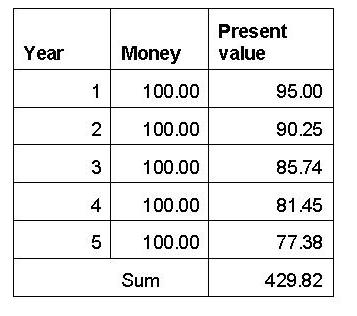
Rs.100 next year is not equal to the same amount available today. When adjusted for 5% inflation, next year’s Rs.100 would be worth Rs.95 now. Cash flows of Rs100 each for five years in the future does not really equal to Rs. 500 at present.


If some one borrows some money from you now with a promise or returning back Rs.100 five years later, the money you are likely to lend him is Rs.77.38 & not Rs.100.

Given this backdrop of present value concept, let us now see what could be the present value of a taxi business. Mr.X runs a cab which is likely to earn the following amount of money after paying for driver, police (??) and tax departments. At the end of 3 years, the taxi becomes non-operational and it’s salvage value would be Rs.1.5 lakhs.

End of year 1:
Earnings from operation = Rs.60,000
Equivalent Present value = Rs.57,000

End of year 2:
Earnings from operation = Rs.50,000
Equivalent Present value = Rs.45,125

End of year 3:
Earnings from operation = Rs.60,000
Total money including salvage value = Rs. 2,10,000
Equivalent Present value = Rs 1,80.048.80

Total net present value of all future money = 57,000 + 45,125 + 1,80.048.80 = Rs.2,82,173.8

Given the expected earnings from operations are intact, it is not prudent in paying more than Rs2.8 lakhs for this business. This applies to any investment be it in shares, research, education, bank deposits, lending money or even delaying you dowry.

Monday, May 22, 2006

Attitude on market crash

Kuppusamy Chellamuthu


There was a cartoon in the Sunday edition of Hindu Business Line. An investment advisor is seen with band-aids on his fractured forearm rapped around the neck. And he says, "Yes..the same guy who sent me sweets when the Sensex first reached 10,000, did this now"
How true? When the market reached 10,000 points fro 9,000 points we all were delighted. It is hardly 3 months from then and the situation is no bad than it was then. What is the reason to feel sad?

Some people bought at low levels and hence afford to appreciate the above logic. But what about folks got in at higher levels? 12,000 and above.. what the **** is the problem? You buy a house for Rs.10 lakhs as you are fully convinced that it is worth that money. Some days later somebody offers you 9 lakhs to buy the house from you. He also sells a similar house he owns for 9 lakhs to another guy. In fact he is also ready to sell another such house to you as well for 9laks. Is it not good?
How does that affect you? Some one else selling his property should not affect you as you bought it for what you thought it deserves. Right? Then why worry??

Indeed it should make you happy. I tell you why.. you buy a business for value X and the same business is available at 0.75X with in days. There is absolutely nothing to worry. May be the ones buying now get it much cheaper than what you paid. But you certainly did not pay much if your decision was not influenced by the market condition and performance of others.
While it is true that this is hard to digest as emotion and money are involved here in great deal. But still we all learn from mistakes, sometimes our own and sometimes from that of others. Learning is not learning until it helps avoiding the same mistake again.

If you had bought with though of selling your positions off at a higher level (say 13 k or 15k), then by definition you are not an investor. No one would say, "I invested in a house for 10 lakh and would sell it for 15 lakhs after a week". He is trading/manipulating/speculating and for god sake not investing. If that is the intention people buy stocks with, yes.. this mail might seem another bluff....

This group has some successful derivative trader and I am not really sure how far it would be appreciated by them. I can afford to talk philosophy even in pain. When compared to the deep declines in January and April 2005, I am doing better with October 2005 and May 22, 2006 declines. Wait until a good ball is bowled. Mr.Market sees nothing but negative things for the investment and real world these times.

Rahul Dravid style of investing


Kuppusamy Chellamuthu

Rahul Dravid, the captain of Indian cricket team is a dream hero, not just for some pretty girls. He is a hero for various people ranging from observers, fans, aspiring young player, team mates etc.. When we partied at a friend’s home, there was an opportunity to meet a person who is a bank employee. He remembered his days when he played together with Rahul for India cements.

“Dravid is still the same. He won’t engage in any kind of rubbish talks especially on matters involving other players on matters other than cricket. Pretty confined and composed person he was with focus on the game every minute. His dedication stood him out among others. I am confident these are the qualities that took him this high in his career”

How true? I was exhilarated hearing this banking officer talk about the captain.

Note: I have allocated one full chapter Rahul Dravid investment style in my stock market book 'The Science of Stock Market Investment - Practical Guide to Intelligent Investors'

In him, we can not see the kind of aggression, excitement, attack seen with Sehwag and Dhoni. Does that mean that he is no important that the rest? Certainly not. As a matter of fact, Dravid is the key player and stands out to be a pillar of the team. He is very very successful player for ages with his consistency & perseverance. His strength is to tire the bowlers till they get weak while keeping him at the same sound position.

Benjamin Graham presented a simple investment plan with the help of baseball game. As I could not understand the game of baseball to the extend the investing game was understood and also our immense proximity to cricket, I developed a conviction that the same plan could be based on Dravid’s style of batting. As investors we have a lot to lean from Dravid.

Unlike test cricket, the game of investing is played for life time. Every stock quote is like a delivery bowled outside the off stump. Unless we go & hit the ball, the ball does not warrant us to hit it.

When the bowler gets tired or when an out of form bowler comes in to attack, you can expect loose deliveries. These are the times for which Rahul conserves his energy for. A 4 or 6 is in the offering. Here we have an edge over Dravid in the sense that he can only get a maximum of 6 runs in a ball. But in the market we can even go for & hit with crores & crores of money. Then… sit back & relax till next loose delivery is bowled no matter how many overs later.

We do not loose the wicket for not having played a ball or some overs at a stretch. Bowler keeps on bowling even when we don’t want to bat. Fine.. there are no stumps in BSE & NSE. The only way we get out is to play some bad shot and been ‘caught out’.

Some times we might have exercised inaction on some plump deliveries which should have been put away with ease in great style. That is ok.. we did not loose anything; it is only that we missed an earning opportunity. Having missed such a ball should not force us to go after the next delivery madly even if it is a yorker.

Very easy it is to play like Dravid. He is not expected to score runs of every delivery like Dhoni. Almost all mutual fund managers do not have that freedom to imitate Rahul, simply because they are compared with other player over after over, if not ball after ball. They are horses. Their fans and people bet on them always want these horses to perform tirelessly.

Hence there is no pressure from outside to be like Dravid for an individual investor like you and I. That does not let us be free from pressure, the pressure from inside. Not able to keep the money for some good investment opportunity might force to take any horse that came out first last hour. Yes.. pressure is purely internal and it is highly difficult to control emotions. Your girlfriend’s aunt made few thousand bucks in day trading does not have anything with you to trade. Even Harbajan can hit some ball to the fence. Does that mean that Dravid should imitate him?? Our worst enemy is nowhere but inside us.

It is equally bad to defend crazily easy deliveries. Do not even try for single or two, but got for the maximum, provide you know it is the ball that matches your line & length requirements. Some times full toss loose deliveries are for you to take. You are insane if you do not leverage (margin purchase or derivatives or whatever) with such investment opportunities. They occur once in a green-moon.

You may not know the delivery that could cost your wicket. That is not a problem. It is fair enough to know the delivery with which you can add up your score. Knowing what you know and playing the game according to your strengths is seldom practiced by investors. Are you one among them?

Any bad pitch in bad weather condition could yield you at least 5 deliveries to score in a 5 day test match. That is all what we need. Any bad economic condition in the worst of recession could provide you at least 5 investment options in a year. What else do we need?

Even for Dravid, sometimes it is not irrational to go for unconventional shots like reverse sweep. He might probably know there is no fielder and also probability of getting out is nil. Derivatives instruments are similar to that. They are to be played at the surest of the deliveries.

“Investors, please do not deal with derivatives and day trading each day. Know what? I don’t play reverse sweep at every delivery” says Dravid. Do we listen?